Midsoft has been working with Defra to explore the practical scenarios for the next stage of Digital Waste Tracking (DWT). One of the key developments is how waste movements will be identified and recorded when the requirements extend to carriers.
As the waste industry prepares for the next phase of Digital Waste Tracking in 2027, attention is turning to the practical process of moving waste from collection through to delivery at a receiving site.
Through ongoing discussions with software developers, including Midsoft, Defra is working through how the digital process will operate in real-world situations.
One of the straightforward scenarios involves a skip being collected and delivered to a waste receiving site.
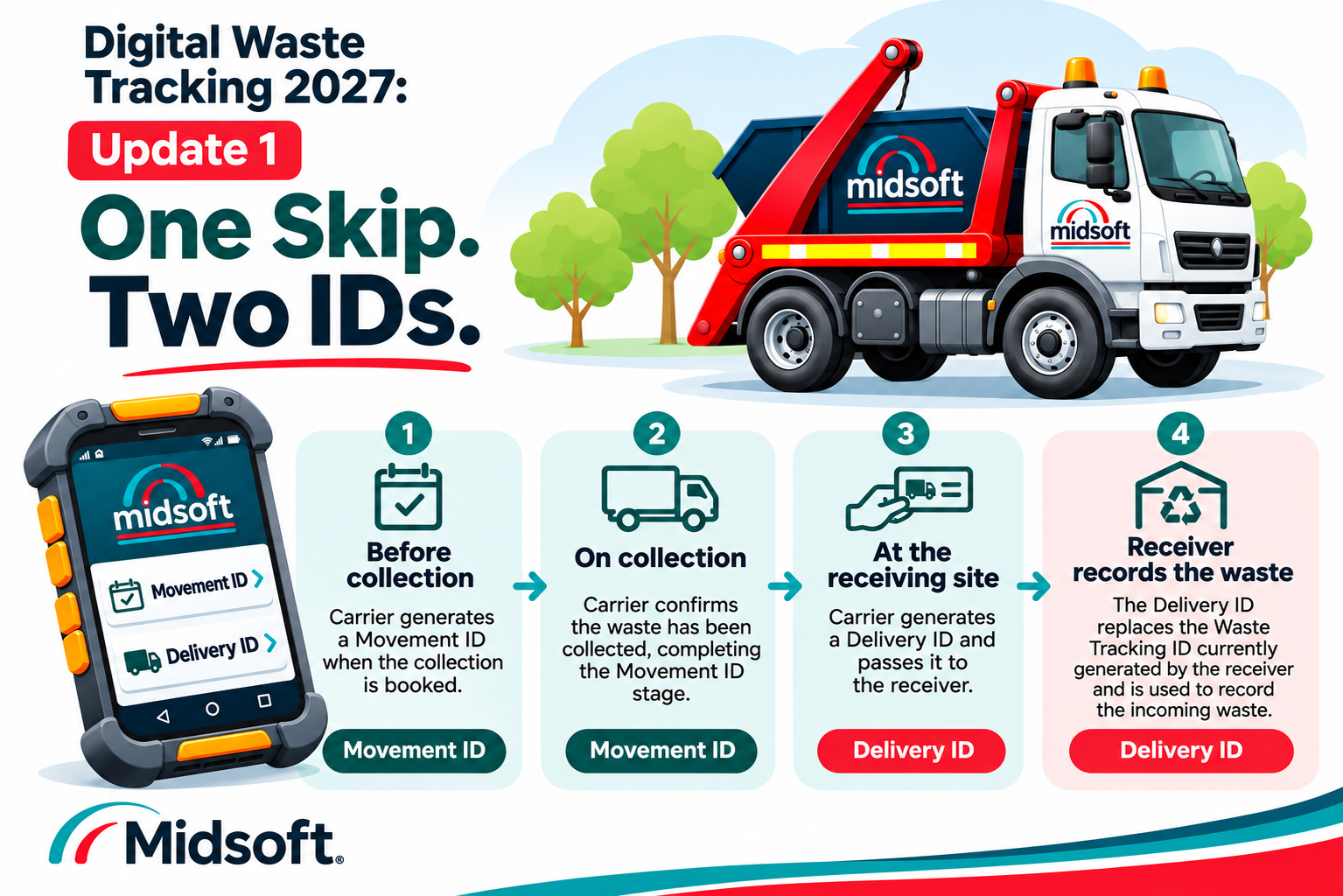
Under the process currently being developed, a single skip movement will involve two identifiers: a Movement ID and a Delivery ID.
The Movement ID is created by the carrier as part of the digital record for the waste movement.
For a skip operator, this forms the first stage of recording the collection and movement of waste.
Rather than the receiving site initiating the entire process when a vehicle arrives, the carrier will have responsibility for creating the initial movement record.
The Delivery ID is associated with the delivery of the waste to the receiving site.
It enables the receiving site to identify the relevant movement and record the waste it has received.
The two identifiers serve different purposes within the overall digital tracking process.
In the straightforward scenario being developed with Defra, the process follows four stages:
The aim is to create a connected digital record of the movement from collection through to receipt.
For businesses using integrated software, the opportunity is to pass the relevant information between the carrier and receiving site without repeatedly entering the same details.
The straightforward process is only part of the picture.
Defra is also working through more complicated operational scenarios with software developers.
For example:
What happens if a registered carrier arrives at a receiving site without having created a Movement ID?
And what happens if the carrier has recorded the movement but cannot generate the Delivery ID because there is no mobile signal?
These are practical situations that need to be considered when designing a system that must work across the waste industry.
Defra has made clear in its discussions with developers that there will not be a manual reporting system for carriers. This makes it particularly important that the digital process can accommodate the realities of day-to-day waste operations.
The procedures for these more complex scenarios are still being discussed and should not be treated as finalised.
Midsoft has been developing waste-management software for decades, working with skip operators, waste carriers and receiving sites of different sizes.
Our Managing Director, Andrew Dyble, has been discussing the proposed carrier processes directly with Defra, helping identify how the requirements will operate in practice.
These discussions are particularly relevant to smaller operators, who may not have sophisticated office systems or dedicated administrative staff.
Midsoft continues to develop its SkipTrak Cloud and MidWeigh software to support waste operators and receiving sites as Digital Waste Tracking requirements evolve.
The objective is to help businesses manage their everyday operations while meeting the developing Digital Waste Tracking requirements.
Defra is continuing to work through the more complex scenarios with software developers ahead of the next stage of implementation.
Although the straightforward two-ID process has been described to developers, detailed arrangements for other situations remain under development.
Midsoft will continue sharing practical updates as further information becomes available.
For more information about Digital Waste Tracking and Midsoft’s software solutions, visit our Digital Waste Tracking Knowledge Centre or contact the Midsoft team.
Important: This article reflects information shared with Midsoft during developer discussions with Defra as at 6 November 2026. It describes the process being developed, not a final published technical specification or statutory guidance.

© 2026 Midsoft. All rights reserved.