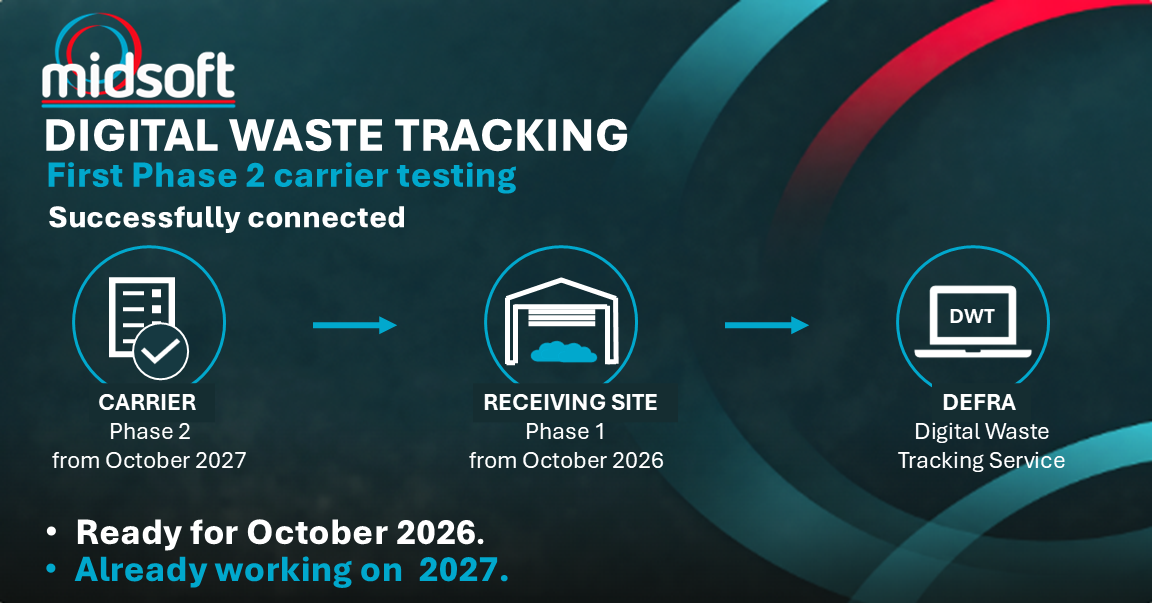
With mandatory Digital Waste Tracking now underway for receiving sites, attention is inevitably turning to what comes next.
At Midsoft, ours already has.
Our development team has now successfully connected to Defra’s Digital Waste Tracking service as part of our first Phase 2 carrier testing, as we begin preparing SkipTrak Cloud for the additional processes that will be required.
The next stage is looking at how those requirements work across real waste operations — because connecting to Defra is only one part of the challenge.
The current requirements focus largely on waste being received at a site.
The next stage brings the waste carrier much further into the digital process — and that means Digital Waste Tracking starts to affect many of the processes and information businesses currently associate with Waste Transfer Notes.
That matters because collecting and delivering waste isn’t always a simple journey from A to B.
A carrier may collect waste from its own customer, work on behalf of a broker, make several collections during the day, use different receiving sites or return a load to its own yard.
The information required for Digital Waste Tracking therefore has to fit into the way those businesses actually work.
Connecting software to Defra is only part of the challenge.
The much more important question is:
How do you collect the information required for DWT without making the people doing the job enter the same information twice?
A waste business may already hold customer details, collection information, waste descriptions, vehicle information, weights and destination details as part of its normal operation.
A properly integrated system should make use of that information.
Otherwise, Digital Waste Tracking risks becoming another administrative task sitting alongside the day-to-day operation rather than being part of it.
SkipTrak has been developed around the operational processes of waste businesses for more than 20 years.
As the next phase of DWT develops, we’re testing how the new requirements interact with those existing processes — from taking the original order through to collection, transport and delivery.
We’re deliberately not rushing to add another form or spreadsheet-style process.
Our aim is to make DWT part of the job that’s already being done.
Because for a busy waste operator, the best compliance process is one that doesn’t create another job in the first place.

© 2026 Midsoft. All rights reserved.